


Dog Sled Mushing Equipment Guide 2026, Parts and Gear
Before a dog team leaves the start line, every piece of équipement traîneau mushing, or dog sled mushing equipment, has a precise role. The runners carry the load, the lines transmit the dogs' effort, the brake and snow hook keep the team under control, and each harness has to fit an individual dog. Understanding this anatomy helps beginners, enthusiasts and curious travellers see what really happens on the trail. In this 2026 guide, we explain each component, how it works and how to check it before a run.
Temps de lecture : 10 min
Dog Sled Mushing Equipment (équipement traîneau mushing) Guide 2026, Parts and Gear

What equipment do you need for dog mushing?
Types of mushing equipment
The answer depends on the activity, the number of dogs and the terrain. A basic setup usually includes a sled or wheeled vehicle, a braking system, lines that suit the team, well-fitted harnesses, a way to anchor the sled during stops, and safety equipment for the musher. Associations such as the Pacific Sled Dog and Skijor Association (PSDSA) and the Australian Sleddog Sports Association (ASSA) present mushing gear as a complete system rather than a single object. Each part depends on the others.

It also helps to separate equipment into three categories. Essential gear is what you cannot safely run without, such as harnesses, lines, a brake and an anchor. Recommended gear improves comfort and safety, such as booties or a sled bag. Race gear is what an organiser makes mandatory for a specific event, and it varies from one race to another.
A recreational outing does not necessarily require everything on a race list, so always check the rules of the organiser or the trail you plan to use.
Dog sled anatomy, the parts of a dog sled explained
Sled structure and materials
A sled carries the musher, equipment and sometimes a passenger, while allowing the team to be steered and slowed down. Infographics such as the one published by Kearney Dog Sled Races show the same main components on most recreational sleds.
The runners are the two long skids that glide on the snow. The musher stands on their rear sections, and shifting weight from one runner to the other helps steer the sled through turns. Runners often have replaceable plastic bases that protect them from wear.
The basket is the load area between the runners. Depending on the design, it holds gear, a sled bag or a seated passenger. On the guided rides we offer in Val Cenis, this is where children and adults sit while an experienced musher drives the team.
The brush bow is the curved piece at the front of the sled. It protects the front from impacts and helps the sled deflect off obstacles such as branches or snow ridges. The stanchions are the vertical posts that connect the runners to the upper frame and give the structure its stability and flexibility.
The drive bow, also called the handlebar, is the bar the musher holds. It is used for balance, steering and keeping contact with the sled on uneven terrain.
Sleds are built from different materials, including wood, plastic, aluminium and composites. Each has its own advantages, and no material is universally better than another. The right choice depends on the type of use, the weight carried and the snow conditions.
Controlling the team, dog sled brake and drag mat, snow hook and snub line
Brake and drag mat
Control is the most important function of any dog sled equipment. Most sleds have two complementary systems. The claw brake is a metal bar with teeth, mounted between the runners. When the musher steps on it, the claws dig into the snow to slow down or stop the sled. It is effective but aggressive, so it is mainly used for firm stops.
The drag mat is a strip of rubber or similar material that hangs between the runners. By putting more or less weight on it, the musher adjusts the speed smoothly without fully stopping. Experienced mushers use it constantly on descents to keep the team at a comfortable pace for the dogs.
Snow hook and snub line
The snow hook for a dog sled is a metal anchor attached to the sled by a line. During a stop, the musher drives it into the snow so the team cannot pull the sled away. It is not designed to hold a team indefinitely, and a musher should never leave an anchored team unattended.
A snub line is used to secure the sled to a fixed point, for example before departure, when the dogs are excited and pulling hard. The PSDSA lists the snow hook, the sled bag and the bridle among the standard items attached to a sled.
Important
The sources we consulted do not justify a universal strength rating for carabiners, snaps or anchors. Follow the manufacturer's instructions and the organiser's rules rather than a generic figure.
Sled dog harness types and how a harness should fit
Choosing and fitting a harness
The harness transfers the pulling effort from the dog to the line. Mushing associations insist that fit matters more than any other criterion. A poorly fitted harness can rub, restrict movement or shift the load to the wrong part of the body.
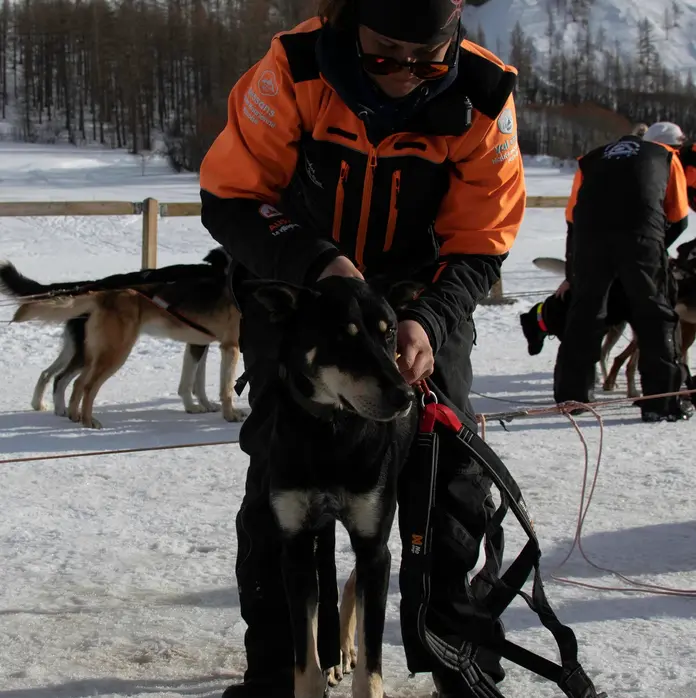
The X-back harness is a common model when the dog pulls in front of the musher. Its straps cross over the back and extend towards the base of the tail, spreading the effort along the body. The H-back harness has a different strap layout and is used in several disciplines. The half harness is shorter and leaves more freedom of movement, which some mushers prefer for certain dogs or activities. None of these models suits every dog.
Harness fit and sizing should be checked individually. Manufacturers such as Alpine Outfitters publish measurement guides explaining how to measure a dog before choosing a size. In practice, the neck opening should sit comfortably without choking, the straps should not rub under the front legs, and the harness should not slide sideways when the dog moves.
Body types differ widely. An Alaskan Husky, a Eurohound and a Siberian Husky do not have the same build, so a harness that fits one dog perfectly may be wrong for another. You can learn more about these differences on our page dedicated to sled dog breeds.
Gangline, tugline and neckline, the lines that connect the team
The gangline, also called the towline, is the main line connecting the team to the sled or vehicle. It runs down the centre of the team, with the dogs positioned in pairs on each side. At the sled, it is attached to the bridle, a rope assembly that spreads the pulling force across the sled frame.
The tugline connects each dog's harness to the gangline. It is the line that actually carries the dog's pulling effort. The neckline connects a dog's collar to the gangline or to its partner, keeping the dogs side by side and facing forward. Necklines guide position, they do not pull. Many setups also include a shockline, an elastic section that absorbs part of the jolts when the team accelerates or the sled hits bumps. This protects both dogs and musher.
Terms and configurations vary with the number of dogs and the activity. A tangle-free line setup is essential. Before departure, lines must be laid out straight, without knots or twists, so that no dog gets caught when the team starts moving. Best in Snow recommends checking for tangles before leaving and inspecting the equipment regularly.
Dog booties for mushing and equipment for the musher
Dog booties are small fabric covers that protect the paws. They appear on most equipment lists, but whether a dog needs them depends on the conditions, the terrain and the individual dog. Icy crust, abrasive snow or long outings may justify them, while soft snow often does not. The sources we consulted do not provide a veterinary protocol, so any injury or doubt should be discussed with a veterinarian.
The musher's equipment is just as important as the dogs'. For a mushing equipment list for beginners, the ASSA guide recommends the following items:
a helmet
clothing adapted to the weather
closed shoes
lights for the scooter or helmet when visibility requires it
a line cutter or emergency cutting tool able to cut lines or a harness quickly
equipment to restrain or transport the dogs, depending on the outing
This list should be adapted to the duration, weather, terrain and local regulations.
Sled vs scooter mushing equipment
Mushing is not limited to snow. Without snow, teams pull a wheeled rig, a dog scooter, a bike or a cart. The ASSA guide mentions the scooter for small teams, and Alpine Outfitters distinguishes scooter lines from gangline configurations used with sleds. Dryland mushing is popular in flat countries with little snow. In the Netherlands, for example, many enthusiasts train on forest paths or near urban areas with scooters and bikes. Some equipment is shared between disciplines, but the vehicle and the lines must match the activity.
Element | Snow sled | Scooter or wheeled rig |
|
Element | Vehicle | Sled with runners, basket, brush bow and drive bow | Scooter, bike or cart with wheels and handlebar |
Braking | Claw brake and drag mat | Mechanical brakes on the wheels |
|
Anchoring | Snow hook and snub line | Fixed point attachment, as a snow hook does not hold on hard ground |
|
Lines | Gangline with tuglines and necklines, adapted to team size | Lines designed for scooters or small teams, often with a shockline |
|
Harness | Fitted individually to each dog | Fitted individually to each dog |
|
Musher safety | Weather-adapted clothing, cutting tool | Helmet, closed shoes, lights when needed, cutting tool |
|
Wheeled rig and dog scooter vehicle compatibility is a key point. The lines must have the right length for the vehicle so dogs never run too close to the wheels. At our dog's home in the Haute Maurienne Vanoise, we use a cani-kart outside the snow season, so families and active visitors can discover sled dogs all year round.
A mushing safety checklist before every run
The ASSA guide recommends inspecting lines, harnesses, collars, brakes, lights and wheels before each outing. Here is a simple routine to follow before departure:
Examine lines and connections for wear and fraying, cuts or chew marks.
Check carabiner and clip inspection points: every snap should open and close freely and lock correctly.
Test the brake, the drag mat and the snow hook.
Check the fit of each harness and collar once the dog is dressed.
Make sure the equipment suits the outing, the team and the conditions.
Lay out the lines straight and tangle-free before hooking up the dogs.
Any damaged item should be repaired or replaced before leaving, never during the run. Best in Snow also recommends monitoring the dogs' hydration, a reminder that a safety check covers the team as well as the equipment.
Good to know
A short inspection takes a few minutes, but it prevents most equipment incidents on the trail. Experienced mushers make it a habit before every single run.
How we use dog sled mushing equipment at Husky Adventure
In Val Cenis and across the Haute Maurienne Vanoise, our professional mushers apply these checks every day. Each dog has its own harness, chosen for its body type, and our lines are inspected before every departure. Our approach to dog sled mushing equipment follows the same logic as our approach to the dogs themselves: their wellbeing comes first.
This is also why we favour a mid-distance philosophy in competition, with longer resting times for our dogs. Our happy sled dogs live in a modern dog's home, and visitors can meet them and see their daily routine up close.
During our sled rides, passengers sit in the basket while a musher drives, and those who want to go further can join an introduction to driving a team, learning how to use the brake, the drag mat and the snow hook under supervision. In summer, canicross, husky hiking and cani-kart let you discover the same principles of harness and line work without snow. All our activities are offered in English.
Final thoughts on dog sled anatomy and gear
Dog sled anatomy is more than a list of parts. Runners, brush bow, stanchions and drive bow make up the vehicle, the claw brake, drag mat and snow hook keep the team under control, and the gangline, tuglines and necklines connect everything to dogs wearing harnesses fitted to their bodies. Whether you are preparing your first outing, training on a scooter in the Netherlands or simply curious, understanding this equipment helps you respect the dogs and travel safely. To see it all in action, come and meet our sled dogs in Val Cenis.
FAQ
Is race equipment different from recreational mushing gear?
Often, yes. Race organisers can make certain items mandatory, such as a specific sled bag, booties or emergency equipment, and these requirements differ from one event to another. For recreational outings, the equipment depends mainly on the terrain, the weather and the team, so always read the rules of the event before entering.
Do I need my own equipment to try dog sledding?
No. With a professional structure, all the dog sled equipment, harnesses and lines are provided and prepared by the mushers. At Husky Adventure, you only need clothing adapted to the season, and our team explains how everything works before departure.
What is a sled bag used for?
The sled bag sits in the basket and holds equipment such as spare lines, booties, a cutting tool or water. In some situations, it can also be used to carry a tired or injured dog back to the finish safely.
Why are tuglines and necklines different lengths?
They do different jobs. The tugline must leave the dog enough room to run and pull freely, while the neckline only keeps the dog in position beside the gangline. Exact lengths depend on the setup and the manufacturer, so it is best to follow the guidance of the line maker or an experienced musher.


Commentaires